
One of the biggest concerns learner drivers have before their practical driving test is making mistakes. The good news is that your examiner isn’t expecting a perfect drive. Instead, they’re assessing whether you can drive safely, confidently and independently.
During your driving test, any mistakes you make will be recorded as either a driving fault, a serious fault or a dangerous fault. Understanding the difference between these fault categories can help you prepare more effectively and give you greater confidence on test day.
At a Glance
- You can receive up to 15 driving faults and still pass your practical driving test.
- One serious fault will result in a fail.
- One dangerous fault will result in a fail.
- Examiners assess faults based on safety and how your actions affect other road users.
- The aim is to become a safe driver, not simply avoid faults.
Every learner makes mistakes while learning to drive. The key is recognising them, learning from them and building the skills needed to drive safely and confidently in a wide range of road and traffic conditions.
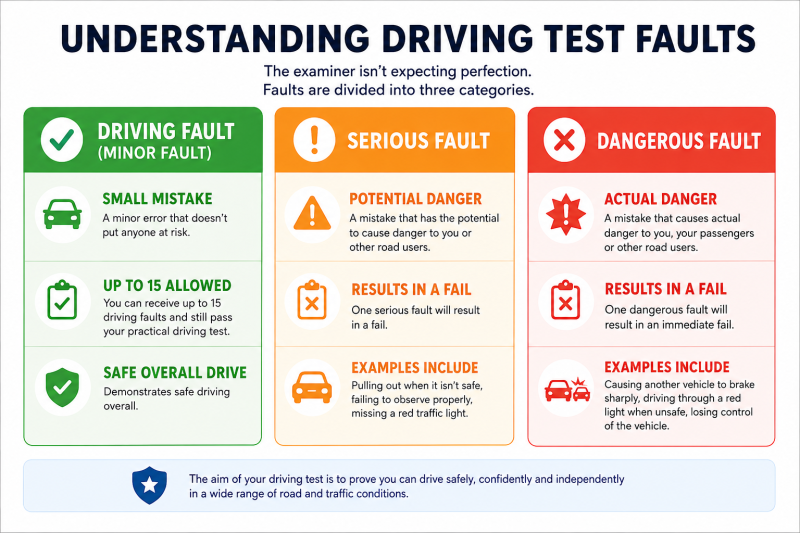
Understanding the difference between driving faults, serious faults and dangerous faults can help you prepare more effectively for your practical driving test.
What are driving faults?
Driving faults, often referred to as minor faults, are mistakes that aren’t considered dangerous on their own. They’re usually small errors that don’t put you or other road users at risk, provided they don’t happen repeatedly or develop into something more serious.
Examples of driving faults include forgetting to check a mirror before signalling, selecting the wrong gear or hesitating slightly at a junction when it was safe to proceed.
What is a serious fault?
A serious fault is a mistake that has the potential to cause danger to you, your passengers or other road users. Receiving just one serious fault during your practical driving test will result in a fail.
Examples of serious faults include pulling out at a junction when it isn’t safe, failing to observe properly at a roundabout or missing a red traffic light. Although no actual danger may occur, the examiner believes the situation could have become unsafe.
What is a dangerous fault?
A dangerous fault is more serious because it involves actual danger being caused during the driving test. This could put you, your passengers, the examiner or other road users at immediate risk.
Examples include forcing another vehicle to brake sharply, driving through a red traffic light when another vehicle has priority or losing control of the vehicle in a dangerous situation. Receiving one dangerous fault will result in an immediate fail.
How many driving faults can you get and still pass?
You can receive up to 15 driving faults during your practical driving test and still pass, provided you do not receive a serious or dangerous fault. However, repeatedly making the same mistake may cause the examiner to record a serious fault if it demonstrates a lack of control or awareness.
Rather than focusing on the number of faults you’re allowed, aim to drive safely, plan ahead and show the examiner that you can drive independently in a wide range of situations.
| Fault Type | Can You Pass? | Example |
| Driving Fault | Yes (up to 15) | Forgetting a mirror check |
| Serious Fault | No | Pulling out when it isn’t safe |
| Dangerous Fault | No | Causing another vehicle to brake sharply |
Common examples of driving faults
Understanding the most common driving test faults can help you focus your practice and avoid unnecessary mistakes on test day. Here are some of the faults examiners record most frequently.
Observation
Failing to observe properly at junctions, roundabouts or when moving away is one of the most common reasons learners receive faults. Always take your time, look carefully in all directions and make sure it’s safe before proceeding.
Mirror checks
Examiners expect you to check your mirrors before changing speed, changing direction or moving away. Missing a mirror check may result in a driving fault, while repeatedly failing to use your mirrors could become a serious fault.
Positioning
Keeping the correct position on the road demonstrates good planning and control. Incorrect positioning when approaching junctions, roundabouts or bends can result in driving faults and, in some situations, serious faults.
Speed
Driving consistently below the speed limit without good reason or exceeding the speed limit can both result in faults. The examiner wants to see that you can choose an appropriate speed for the road and conditions.
Signals
Signals should always be given clearly and at the correct time. Missing, late or misleading signals can confuse other road users and may lead to faults.
Junctions
Approaching junctions at the correct speed, choosing the right position and making effective observations are all essential. Many driving test faults occur because learners rush decisions or fail to plan ahead.
How can you avoid driving test faults?
Take regular driving lessons
Regular driving lessons help you build confidence, improve your observation skills and develop safe driving habits. Consistent lessons also allow your instructor to identify areas that need improvement before your test.
Practise between lessons
If you have access to a suitable car and supervising driver, private practice can reinforce what you’ve learnt during your driving lessons and improve your confidence in different road and traffic conditions.
Take a mock driving test
Mock driving tests recreate the conditions of your practical driving test and help identify any weaknesses before the real test. They also help reduce nerves by making the experience feel more familiar.
Learn from your mistakes
Every learner makes mistakes. The important thing is understanding why they happened and making sure they don’t become repeated habits. Your driving instructor will help you improve in the areas that matter most.
Frequently Asked Questions
How many driving faults can you get and still pass?
You can receive up to 15 driving faults and still pass your practical driving test, provided you don’t receive a serious or dangerous fault
Can you pass with 15 driving faults?
Yes. Although receiving 15 driving faults still results in a pass, the aim should always be to drive safely and confidently rather than focusing on the maximum number of faults allowed.
What’s the difference between a serious and dangerous fault?
A serious fault has the potential to cause danger, whereas a dangerous fault results in actual danger to you, your passengers or other road users.
Do driving examiners have a quota for failing people?
No. Driving examiners assess every candidate against the same DVSA standards. There are no quotas or targets for failing learner drivers.
The examples on this page are for guidance only. Every driving test is different, and faults are assessed by the examiner based on the specific circumstances and the DVSA’s assessment criteria.

Understanding driving test faults and learning from mistakes helps build the confidence and skills needed to become a safe, independent driver.
Ready to prepare for your driving test?
Whether you’re looking for driving lessons, automatic driving lessons or an intensive driving course, our experienced instructors can help you build the confidence and skills needed to become a safe driver. Get in touch today to start your driving journey with Jody Thomas Driving School.
Looking for more learner driver advice? Visit our Learn to Drive Hub for expert guides covering driving lessons, theory tests, practical driving tests and much more.